

There is a gap at the center of how most growing businesses use data.
They collect it. They store it. They build dashboards that tell them what happened last week. And then someone has to read those dashboards, draw conclusions, decide what to do, and manually trigger the next action. By the time that cycle completes, the opportunity has often already moved.
Business intelligence automation is closing that gap. Not by making reports faster, but by eliminating the delay between insight and action entirely. And the best AI agents in 2026 are the mechanism making that possible for teams that could never afford the enterprise infrastructure it used to require.
Why Business Intelligence Has a Timing Problem
Traditional BI was backward-looking by design. Data was collected, processed, analyzed, visualized, and then reviewed by a human who would decide what to do with it. Every step in that chain introduced delay.
For large enterprises with dedicated data teams, that delay was manageable. For growing businesses where one person might wear the roles of analyst, decision-maker, and executor simultaneously, it was not.
Enterprise spending on BI and analytics tools hit $28.1 billion in 2025, growing 14.2% year-over-year, and that investment is driven by one expectation: answers, not just reports.
That shift in expectations is the context for everything that follows. The market is not looking for better dashboards. It is looking for intelligence that acts.
Modern AI business intelligence now guides leaders toward what should happen next, enabling decision cycles that accelerate by 40% to 60% across industries. That acceleration is not coming from humans reading reports faster. It is coming from agents that monitor data continuously, identify what matters, and trigger the appropriate response without waiting for someone to notice.
What Business Intelligence Automation Actually Means in 2026
Business intelligence automation in its current form is not a reporting tool. It is a system where data collection, analysis, decision-making, and action happen in a continuous loop without a human intermediary at every step.
AI agents can continuously scan for anomalies, shifts, or performance changes, alerting teams before issues become problems. Organizations adopting real-time decisioning are discovering something powerful: speed compounds. The faster you react, the more competitive your business becomes.
For a growing team, this matters more than it does for a large enterprise. A company with 200 analysts can absorb the cost of slow BI cycles. A team of 15 people cannot. When the same insight that takes a data team three days to produce can be surfaced and acted on automatically in minutes, the operational advantage for smaller, faster-moving organizations is disproportionate.
Self-service analytics enables non-technical users to explore data, build dashboards, and generate insights without depending on central BI or IT teams. BARC's 2026 Trend Monitor ranks self-service analytics among the top three priorities for organizations building data-driven cultures, citing its role in reducing analyst bottlenecks and accelerating decision cycles.
What the Best AI Agents Do That BI Tools Cannot
A BI tool shows you data. The best AI agents act on it.
That distinction sounds simple. The operational implications are significant.
AI-driven analytics tools represent 40% of all BI investment in 2025. 84% of executives say BI and analytics are critical for their digital transformation roadmap. But investment in tools does not automatically translate into improved decision speed when humans are still the connective tissue between insight and action.
The best AI agents change that equation in three specific ways.
They monitor continuously, not periodically. A human analyst checks a dashboard when they have time. An AI agent watches every relevant metric in real time and reacts the moment something meaningful changes. Revenue pipeline dropping below threshold? The agent flags it and triggers a re-engagement sequence. Invoice overdue beyond the acceptable window? The agent escalates it without anyone noticing the aging report. Cash flow forecast deviating from projection? The alert goes to the right person before it becomes a cash flow problem.
They connect intelligence across functions. The most valuable insights in any business are cross-functional. Sales velocity affects project capacity. Payment delays affect cash flow forecasts. Customer churn signals affect marketing re-engagement priorities. A BI tool surfaces these patterns only if someone has thought to build the right cross-department report. An AI agent that shares context across sales, finance, project management, and marketing surfaces them automatically because it has visibility across all four simultaneously.
They close the loop between insight and action. A revenue agent monitors pipeline health and nudges sales reps on at-risk deals automatically. A finance agent detects expense anomalies and initiates approval workflows without manual intervention. A marketing agent reallocates effort in real time based on live performance signals. In each case, the insight and the action are part of the same workflow. No human bridges the gap.
Enterprise Workflow Automation: What Growing Teams Get Wrong
Growing teams face a specific trap when it comes to enterprise workflow automation. They adopt the tools that large enterprises use, implement them at their current scale, and find that the overhead of managing the tooling is comparable to the overhead of the manual work they were trying to replace.
The reason is architectural. Most enterprise workflow automation tools were designed for organizations with dedicated IT teams to configure them, operations managers to maintain them, and analysts to interpret the outputs. When a team of 15 to 50 people tries to run the same stack, the administration cost is prohibitive.
More than 80% of organizations believe AI agents are the new enterprise apps, triggering a reconsideration of investments in packaged applications. 89% of surveyed CIOs consider agent-based AI a strategic priority, with demand growing for solutions that enhance automation, decision-making, and enterprise orchestration.
The shift that matters for growing teams is not adopting enterprise-grade BI. It is adopting agent-based automation that delivers enterprise-level intelligence without the enterprise-level administration overhead.
The difference is who manages the system day to day. In a traditional enterprise workflow automation setup, someone has to maintain the configuration, update the rules when processes change, and monitor the system for exceptions. In an agent-based setup, the agent handles all of that adaptively. The team's job is to define the goal. The agent figures out how to achieve it.
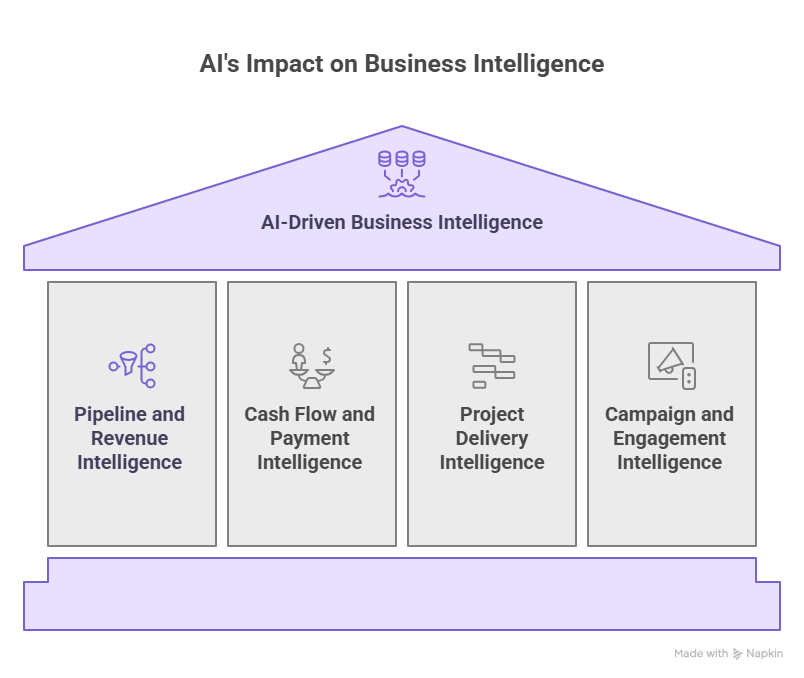
Where AI Agents Are Delivering Measurable BI Value for Growing Teams
The functions where business intelligence automation produces the clearest near-term returns for growing teams share a common characteristic: they involve decisions that are made frequently, based on patterns that a human could identify but does not have time to monitor continuously.
Pipeline and revenue intelligence. Monitoring deal velocity, lead response times, and conversion rates across a pipeline requires continuous attention that most growing teams cannot sustain manually. An AI agent that watches these metrics in real time and surfaces the right signal at the right moment replaces a significant portion of what a dedicated sales analyst would do.
Cash flow and payment intelligence. By 2027, AI-driven BI will account for 70% of enterprise analytics spending. For growing businesses, the most immediate BI value in finance is not forecasting models. It is knowing which invoices are at risk, which payment patterns suggest a collection problem is developing, and which customers are trending toward late payment before the invoice is actually overdue. An AI agent that monitors payment behavior continuously and flags risks early is more valuable to a 30-person company than a quarterly cash flow report.
Project delivery intelligence. Knowing that a project is going to miss a deadline before it misses it requires someone to be watching multiple workstreams simultaneously. For a project manager overseeing several concurrent deliveries, that level of attention is not sustainable manually. An AI agent that monitors task completion rates, workload distribution, and dependency chains surfaces the early warning signals automatically.
Campaign and engagement intelligence. Staff using AI report an 80% improvement in productivity due to the technology. In marketing, the specific productivity gain comes from replacing the cycle of sending campaigns, waiting for results, analyzing performance, and manually deciding what to adjust. An AI agent that monitors engagement signals and adjusts sequences automatically removes that manual loop entirely.
The Coordination Layer Most Teams Are Still Missing
Individual AI agents that handle one function well are valuable. The bigger opportunity, and the one that most growing teams have not yet reached, is coordinating multiple agents around a shared data layer.
Gartner predicts that by 2028, AI agent ecosystems will enable networks of specialized agents to collaborate across multiple applications and business functions. For growing teams, the practical implication is that the agent watching your sales pipeline and the agent managing your project capacity need to share information for the intelligence to be genuinely useful.
When a high-value deal closes, the question is not just "send the invoice." It is also "does the team have capacity to deliver this?" and "which marketing sequences should shift based on this customer now being active?" A coordinated agent system answers all three simultaneously.
WorksBuddy is built around this coordination model. Its agents across sales, marketing, project management, invoicing, contracts, and workflow automation share a live data layer, so the intelligence from one function informs the decisions in another without manual data movement between systems. For growing teams evaluating what coordinated business intelligence automation looks like at the product level, it is a useful reference for understanding the architecture before building or buying a system.
A Framework for Getting Started
The businesses seeing the strongest returns from business intelligence automation are not the ones that deployed the most agents simultaneously. They are the ones that started with the clearest use case.
Scaling starts with the right specific tasks, not overly ambitious projects with no set goals.
A practical starting framework for growing teams:
Identify the one business metric that costs your team the most manual attention. That is the starting point for automation, not the most technically interesting use case, but the one where the cost of manual monitoring is most visible and the benefit of continuous AI monitoring is most immediate.
Define what action the agent should take when the metric crosses a threshold. The insight without the action is still just a report. The value of business intelligence automation is in the closed loop between detection and response.
Measure the before and after over 60 days. The fastest path to expanding automation is demonstrating that the first deployment worked. A single well-implemented use case is more persuasive internally than a comprehensive strategy document.
Final Thought
Business intelligence has always been about making better decisions faster. What changes in 2026 is that the best AI agents make it possible to act on intelligence continuously, across every function of a growing business, without the analyst headcount that was previously required.
Organizations that successfully navigate these trends by building strong data foundations, deploying AI responsibly, and developing organizational capabilities to leverage intelligent systems will unlock sustainable competitive advantages in decision speed, accuracy, and strategic foresight.
The advantage is not in having more data. It is in having agents that know what to do with it the moment it matters.


