

Signing a contract used to mean printing a document, physically signing it, scanning it back, and emailing it to the other party who would repeat the same process. It was slow, error-prone, and completely disconnected from everything else happening in the business around it.
Electronic signature software solved the friction of the physical process. Suddenly contracts could be sent, signed, and returned in minutes instead of days. For businesses that adopted it early, the efficiency gains were immediate and obvious.
But that was only the beginning.
The next wave of transformation in electronic signature software is not about making signing faster. It is about making the entire contract lifecycle smarter. AI is moving into every stage of how contracts are created, negotiated, executed, and managed after signing. Automation is connecting contract workflows to the broader business systems around them. And compliance, always the most complex and high-stakes dimension of contract management, is becoming something that technology handles systematically rather than something that depends on a lawyer remembering to check the right boxes.
For businesses that understand where this is heading, the opportunity is significant. For those still treating electronic signatures as a standalone tool disconnected from their operations, the gap is growing.
Why Electronic Signatures Were Only the First Step
The original value proposition of electronic signature software was clear: eliminate paper, reduce turnaround time, and create a digital record of execution. All of that held up. Businesses that made the switch saw immediate improvements in how fast deals closed and how much administrative effort contracts required.
But the signing moment is actually a small part of the contract lifecycle. Before a signature happens, a contract has to be drafted, reviewed, negotiated, redlined, and approved. After a signature happens, the contract has to be stored, monitored for key dates and obligations, renewed or terminated at the right time, and kept in compliance with whatever regulatory requirements apply to the business or the jurisdiction.
Traditional electronic signature software handled the middle moment brilliantly and left everything around it largely untouched. Drafting still happened in Word documents passed back and forth over email. Negotiation still involved tracked changes and version confusion. Post-signature management still meant contracts buried in shared drives that nobody looked at until something went wrong.
Contract automation software and AI are filling in these gaps systematically, and the result is a fundamentally different category of solution.
How AI Is Transforming Every Stage of the Contract Lifecycle
The integration of AI into electronic signature and contract management software is not a single feature. It is a set of capabilities that apply across the entire contract lifecycle, each one removing a different layer of manual effort and human error.
Intelligent contract drafting. AI can generate first-draft contracts from templates calibrated to the specific deal type, jurisdiction, and counterparty. Rather than a lawyer or operations team member starting from a blank document or hunting for the right template, AI produces a complete draft in seconds based on the parameters of the deal. The human role shifts from drafting to reviewing, which is a far more efficient use of legal and operational capacity.
Automated risk identification. Before a contract goes out for signature, AI reviews it against your standard terms, your risk thresholds, and any regulatory requirements that apply. Clauses that deviate from acceptable terms get flagged automatically. Missing standard protections are identified before they become problems. What used to require a lawyer reading every contract carefully becomes a systematic check that runs on every document regardless of volume.
Smart negotiation assistance. When a counterparty redlines a contract, AI analyzes the changes, categorizes them by risk level, and recommends how to respond based on your company's historical negotiation positions. Teams without dedicated legal resources gain the ability to negotiate with the same systematic rigor that enterprise legal teams apply, without the enterprise legal budget.
Conditional workflow automation. Contract automation software now connects the signing event to everything that happens after it. When a contract is signed, workflows trigger automatically across the business: project kickoff tasks are created, invoices are queued, onboarding sequences begin, and access is provisioned. The contract is no longer an isolated document. It becomes the trigger for an entire operational sequence.
Post-signature obligation monitoring. AI monitors active contracts for key dates, renewal windows, payment milestones, and performance obligations. Instead of relying on someone to manually calendar a renewal date eighteen months into the future and hope that person still works there when the date arrives, AI watches every contract in your portfolio continuously and surfaces the ones that require action before the window closes.
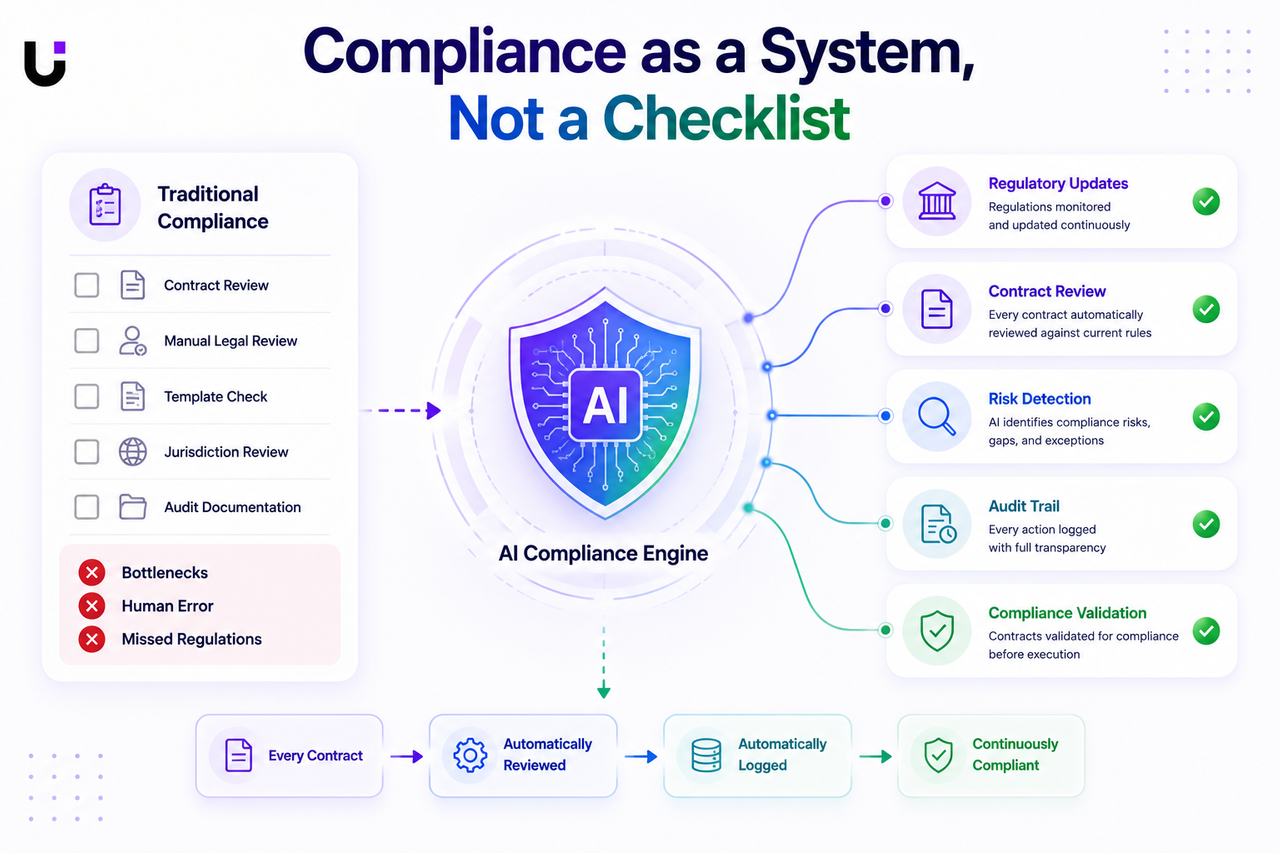
Compliance as a System, Not a Checklist
Compliance has always been the dimension of contract management that creates the most risk and consumes the most resources. Regulatory requirements vary by jurisdiction, industry, and contract type. They change over time. And the cost of getting them wrong ranges from contract unenforceability to regulatory fines to reputational damage that is far harder to quantify.
Traditional approaches to contract compliance relied on a combination of legal expertise, manual review processes, and standardized templates that could only account for scenarios anticipated at the time of drafting. This worked reasonably well in stable regulatory environments with low contract volumes. It breaks down when volume scales, when regulations change, or when contracts span multiple jurisdictions with different requirements.
AI-powered contract management software changes this by treating compliance as a system rather than a checklist. Regulatory requirements are encoded into the AI's review logic and updated continuously as requirements change. Every contract is checked against current compliance standards automatically, not just the ones that make it to a lawyer's desk. Audit trails are generated automatically for every action taken on every document, creating the evidentiary record that regulators and auditors require without anyone manually assembling it.
For industries operating under strict regulatory frameworks such as financial services, healthcare, real estate, and professional services, this is not a nice-to-have improvement. It is the difference between a compliance function that scales with the business and one that becomes an increasingly expensive bottleneck as transaction volume grows.
The Integration Imperative: Why Standalone Is No Longer Enough
One of the clearest trends in the evolution of electronic signature and contract management software is the move away from standalone tools toward fully integrated platforms.
A standalone electronic signature tool does one thing well: it gets documents signed. But in an actual business workflow, getting a document signed is connected to dozens of other processes. A signed sales contract should trigger project creation, invoice generation, client onboarding, and resource allocation. A signed vendor agreement should update the supplier database, create payment schedule entries, and notify the relevant procurement team.
When electronic signature software operates in isolation, all of those downstream connections have to be made manually. Someone has to see that a contract was signed, then go into each relevant system and update it accordingly. This is exactly the kind of coordination overhead that accumulates silently and consumes significant operational capacity at scale.
Contract automation software built on an integrated platform eliminates this entirely. The signature event becomes a workflow trigger that cascades automatically through every connected system, updating records, creating tasks, generating documents, and notifying teams without human intervention at any step.
How WorksBuddy Sigi Leads This Shift
Sigi is WorksBuddy's AI-powered e-signature and document management agent, and it was built around the principle that signing a contract should be the beginning of an automated business process, not the end of a manual one.
Within Sigi, contracts are sent, tracked, and signed digitally with complete visibility into document status at every stage. But the real capability is what happens around the signature. When a contract is sent through Sigi, the entire delivery workflow is already in motion. When it is signed, Taro creates the project, Inzo queues the first invoice, and Evox begins the client communication sequence automatically.
Because Sigi is part of the WorksBuddy platform, it does not require custom integrations or manual steps to connect contract execution to business operations. The connection is native. Every signed contract becomes an operational event that the entire platform responds to in real time.
For small businesses and scaling teams that need the contract management sophistication of an enterprise without the enterprise overhead, Sigi delivers exactly that.
The Bottom Line
Electronic signature software was a meaningful step forward. AI-powered contract automation software is a transformation.
The businesses that will move fastest and operate most efficiently over the next decade are those that treat contracts not as isolated documents to be filed and forgotten but as living operational triggers connected to every system and process in their business. AI makes that possible at a scale and cost that was previously reserved for the largest enterprises with the largest legal and operations budgets.
The future of electronic signature software is intelligent, automated, integrated, and compliant by design. That future is already here for the businesses choosing to build on it.
See how WorksBuddy Sigi transforms your contract workflow at worksbuddy.ai/sigi